
What works instead
We know what makes a city safer.
It's easy to feel like surveillance is the only answer on offer. It isn't — and the evidence is clear about what actually reduces violence. The most rigorously tested approaches don't watch people. They invest in them, and in the places they live.
This is the hopeful part of the story, and it's the best-supported. Here's what the research shows — and what Detroit is already proving.
- 165
- Detroit homicides in 2025 — lowest since 1965
- $26–$333
- returned per $1 spent greening vacant lots
- 86–89%
- of Chicago ShotSpotter alerts that found no gun crime
- ~$10–17M
- what a single homicide costs society — so prevention pays for itself
The evidence
Six things that actually reduce violence
Greening vacant lots
A randomized trial across 541 Philadelphia lots found that simply cleaning and greening neglected land cut gun assaults 29% in poorer neighborhoods — and made residents feel far safer. (A later multi-city meta-analysis pooled a more modest ~4–5% — real, but smaller than the Philadelphia headline.)
Branas et al., PNAS (2018) ↗Brighter streets
Randomly adding high-intensity lighting to New York public-housing developments cut nighttime outdoor crime by at least 36% — a one-time fix, not a database.
Chalfin et al., NYC RCT ↗A summer job for a teenager
Chicago's One Summer Plus cut participants' violent-crime arrests 43% — and most of the drop came after the eight-week job ended, meaning it changed behavior, not just kept kids busy.
Heller, Science (2014) ↗Violence interruption (CVI)
Credible messengers who mediate conflicts before they turn deadly. Baltimore's Safe Streets saw ~22% fewer homicides across mature sites; New York and Bronx programs saw far larger drops in shootings.
Johns Hopkins; John Jay College ↗Therapy that slows the moment down
Cognitive behavioral therapy like Chicago's Becoming a Man cut violent-crime arrests roughly 44–50% in its first trials — teaching young people to pause before a split-second decision.
Heller et al., QJE ↗Send health workers, not always police
Denver's STAR program sends medics and crisis workers — not officers — to low-level calls. It cut targeted offenses 34% with no rise in serious crime, at about a quarter of the cost per call.
Dee & Pyne, Science Advances (2022) ↗Detroit is already proving it
The fewest homicides since 1965.
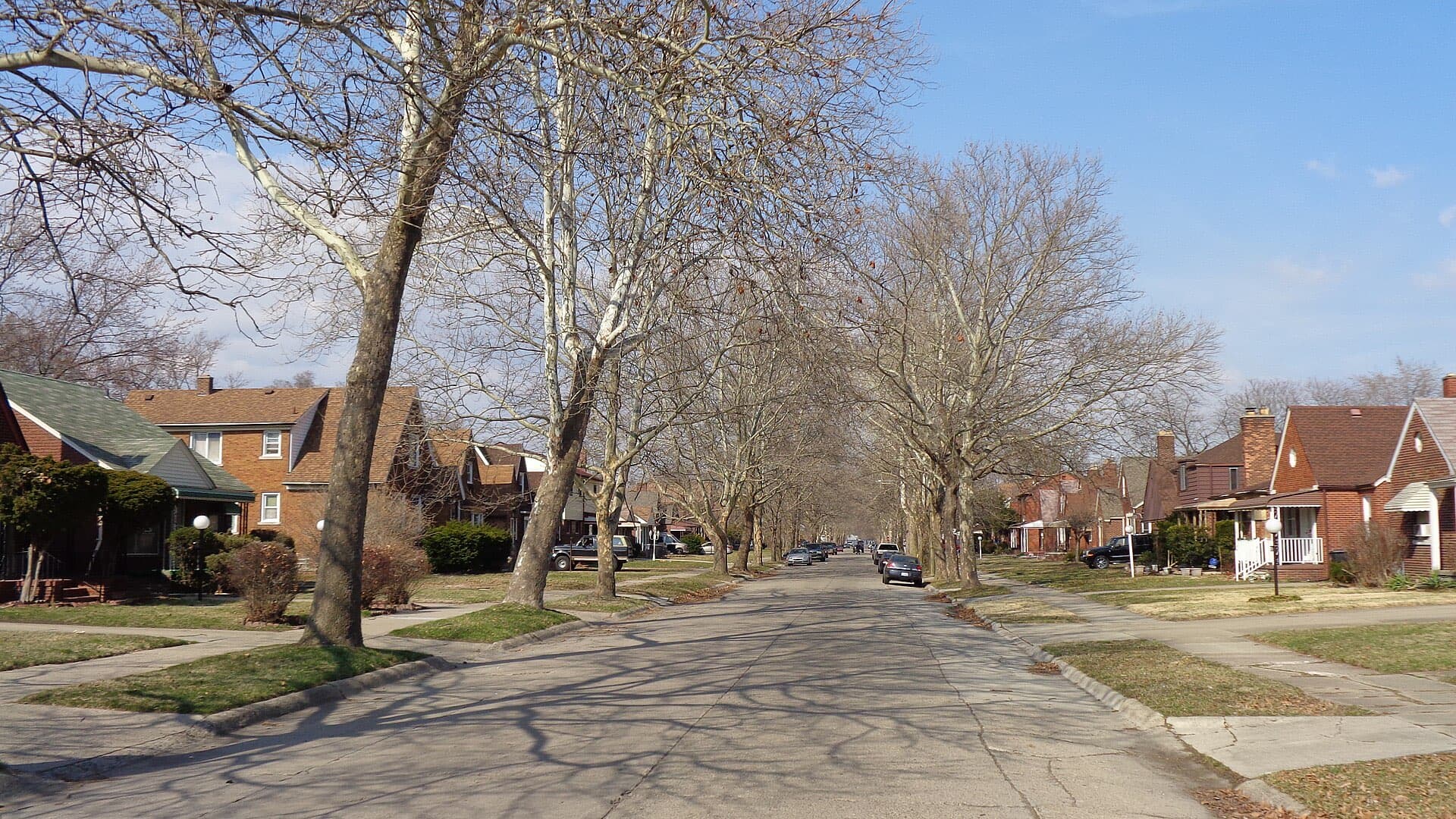
Detroit isn't theorizing about this — it's living it. The city's homicides fell from 252 in 2023 to 203 in 2024 to 165 in 2025: the fewest since 1965, and the first time below 200 in decades. Nonfatal shootings nearly halved over the same span.
A central part of that is ShotStoppers, Detroit's community-violence-intervention program. Neighborhood groups — FORCE Detroit, New Era Detroit, Detroit Friends & Family, Detroit 300, and others — are funded to interrupt violence in their own zones, by people the community already trusts. In 2024, homicides in those CVI zones fell about 45%, versus 18% elsewhere in the city.
An honest note, because credibility is the whole point of this site: those zone figures are the city's own, cover small areas, and haven't been checked by an independent evaluator with a proper comparison group — and because homicides fell citywide over the same years, it's genuinely hard to prove how much ShotStoppers itself caused versus the broader trend. What's solid is the citywide decline and the large, well-tested evidence base behind this kind of community work. The direction is unmistakable, and it points away from cameras, toward people.
Reading the evidence honestly
How to read these numbers honestly: the percentages above come from real studies, but effect sizes vary by city and design — a single randomized trial often shows a bigger drop than a pooled average across many places, so treat each figure as evidence of direction, not a guarantee of size. And the fair question about any neighborhood program is whether crime simply moves elsewhere. The best research says it usually doesn't: reviews find displacement in only about a quarter of cases, and roughly as often the opposite happens — a “diffusion of benefits” that quiets nearby blocks too. The bottom line isn't that these approaches are magic. It's that they're well-supported and cost-effective — and deserve exactly the scrutiny we'd bring to a surveillance contract. Sources: Guerette & Bowers (2009) on displacement; Branas et al. (2018) and a 2021 greening meta-analysis on effect-size range.
None of this is soft, and none of it is naïve. It's the rigorously tested, dollar-for-dollar more effective path — and Detroit is already on it. The question was never whether we can afford to invest in people. It's whether we can afford not to.
Show up when it counts
Decisions get made in rooms.
We'll tell you which room, and when.
The most powerful thing a resident can do is be present before the vote. Subscribe and we'll email you ahead of every City Council session, Police Commissioners meeting, and public hearing that shapes our city.