
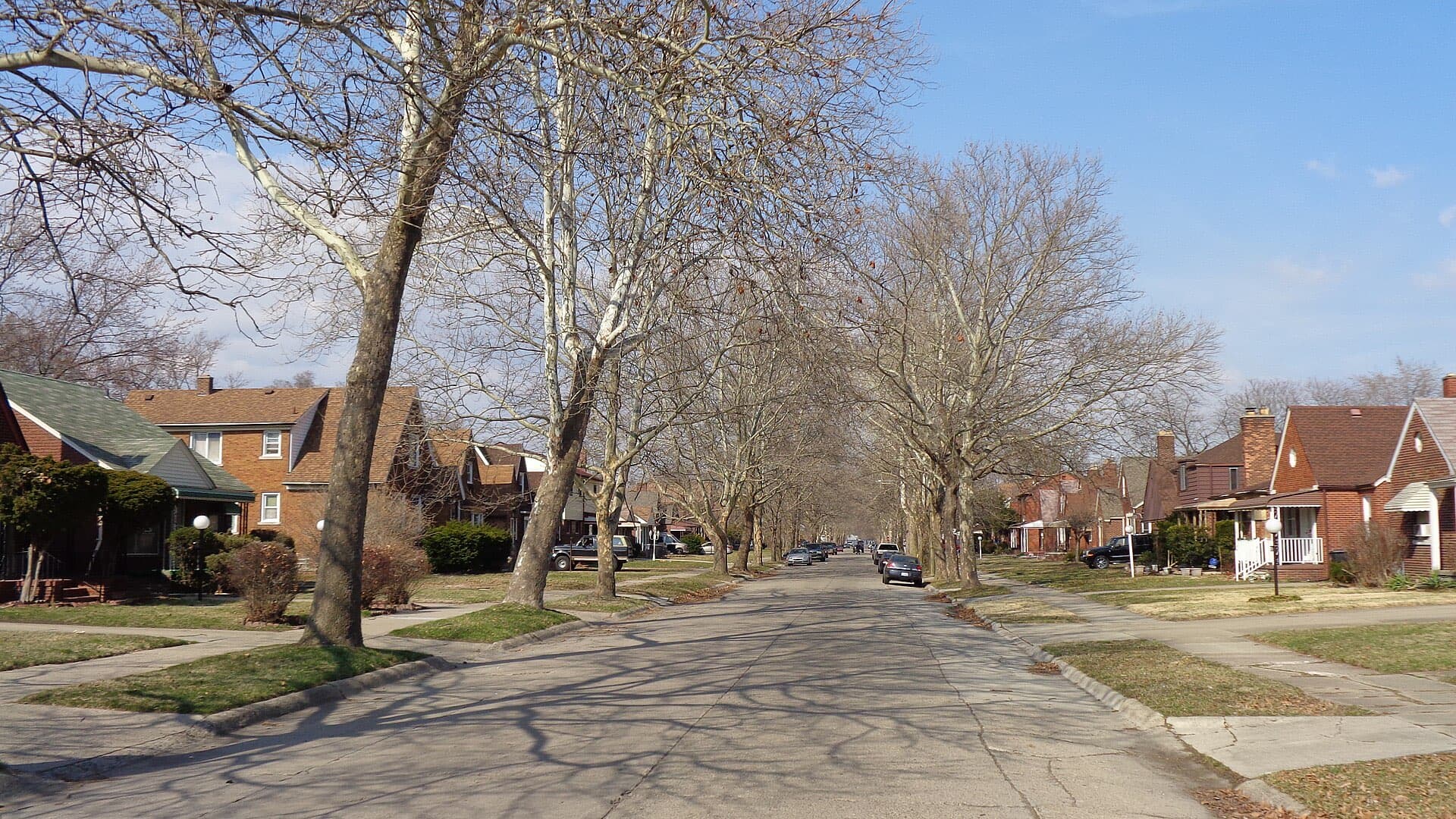
District 3
Built without a permit. Fined zero dollars for it. How Detroit's own enforcement bent for one family — and how a 2019 land swap set the terms for the whole neighborhood.
What you need to know
the fine Kronos Concrete paid for building its Cadillac Heights plant before securing a permit — the city issued a stop-work order, then permitted it months later instead.
BSEED · BridgeDetroit
parcels Crown Enterprises (Moroun family) now owns in Cadillac Heights, up from 34+ transferred in a 2019 land swap.
Planet Detroit, Jul 2026
the year Crown's first-refusal right on every future Cadillac Heights parcel that hits the Land Bank finally expires.
2019 city land-swap agreement
named longtime residents who have sold to Crown since 2019, at an average ~$114,000 per home in 2024.
BridgeDetroit · ProPublica
dust complaints filed to the city since its 2024 ordinance — nearly half naming Kronos.
dust@detroitmi.gov, via Planet Detroit
What happened, in order
In the summer of 2022, Crown Enterprises — the real-estate arm of the billionaire Moroun family, which also owns the Ambassador Bridge — began building a concrete batch plant, Kronos, on multiple parcels in Cadillac Heights, a historically Black neighborhood on Detroit's northeast side. It had no permit. The city's Buildings, Safety Engineering and Environmental Department (BSEED) caught the illegal construction and issued a stop-work order.
Months later, the city issued Crown a permit to operate anyway. No fine was ever assessed for building without one. Council member Scott Benson, whose District 3 includes Cadillac Heights, later said his office reported the violation to BSEED itself — but the plant reopened regardless, this time with paperwork.
The pattern continued after opening. Dust, noise and truck-traffic complaints followed almost immediately. The city adopted a dust-control ordinance in 2024; nearly half of the roughly 80 complaints filed since have named Kronos. The plant has racked up five dust-ordinance violations under its compliance plan — but was fined only once. Two $2,500 tickets were dismissed in 2025, and other penalties were waived under a 2022 property-maintenance agreement that gives Crown up to 30 days to fix any violation before a fine even applies.
No fine was ever assessed for building without one.
Where it started: a $267 million land swap
Kronos didn't appear on empty ground by accident. In May 2019, City Council approved a sprawling $267 million land-swap deal, brokered by then-Mayor Mike Duggan, that transferred 34-plus Cadillac Heights parcels to Crown Enterprises in exchange for land elsewhere that let Stellantis (then Fiat Chrysler) build a new assembly complex promising thousands of jobs. Duggan called it the best day of his tenure. The deal also gave Crown first right to purchase any future Cadillac Heights parcel that lands in the Detroit Land Bank through tax foreclosure — a standing claim on the rest of the neighborhood that runs through 2034.
City Council President James Tate, who voted for the swap, now says in hindsight he'd want “additional protections” if he had the chance to do it again. Mayor Mary Sheffield voted against the deal as a council member; as mayor, her administration has since installed independent air-quality monitors near the plant.
Crown has used that first-refusal position to keep buying. The company now owns more than 160 parcels in Cadillac Heights and has demolished 20-plus structures. At least 16 longtime residents have sold since 2019 — Samantha Flowers sold her home and five parcels for $125,000 in January 2026; Matthew Tomasz sold his home for $150,000 after a legal fight. The average 2024 sale price, per a Crown representative, was about $114,000.
A standing claim on the rest of the neighborhood that runs through 2034.
The oldest pattern in the district
This isn't the first time land assembly for industry has reshaped this stretch of Detroit. In the late 1980s, the Coleman Young administration cleared East Canfield for Chrysler's Jefferson North Assembly plant — more than 600 homes demolished, roughly 2,000 residents displaced, 150 businesses razed. The plant that resulted has grown from 47 acres in 1940 to 461 acres combined with the newer Mack Avenue complex today. Detroit has given the Jefferson North/Mack complex more than 400 acres and spent close to $700 million (inflation-adjusted) on buyouts, cleanup and land purchases since 1925 — including nearly $400 million in tax incentives for the 2019 expansion alone.
That 2019 expansion came with a promise from Mayor Duggan that no residents would be pushed out. The mayor's office maintains that promise held for the plant's own 200-acre footprint — “not a single resident was bought out or displaced,” says spokesperson John Roach, calling the land vacant. Residents describe a different mechanism: not a formal buyout, but self-displacement from odor and pollution. Akishia Hunter moved her family into a hotel after her son's asthma attacks worsened. Binh Phung relocated to Chicago in 2019 and, six years later, still hasn't returned. The Great Lakes Environmental Law Center filed an environmental-justice complaint over the plant's emissions; attorney Andrew Bashi put it plainly: “This facility should have never been permitted to expand into the backyard of residents based on emissions alone.”
Cadillac Heights and the Jefferson North/Mack expansion are two different deals, a mile apart, decades apart in origin — but they share a mechanism: heavy industry expands into a residential-adjacent block, the city's process bends to make room, and the residents who stay absorb what's left.
What the councilman can and can't do
Scott Benson has represented District 3, including Cadillac Heights, since 2013. Asked about the pressure some residents describe to sell to Crown, he's been direct about the limits of his office: “That has nothing to do with me, I made no introductions. I have not inserted myself with this process whatsoever.” He says his office is separately working to strip M4 — Intensive Industrial, the zoning category that legally shields Kronos — from parcels adjacent to residential blocks citywide, a slower, structural fix rather than a fight over one plant.
After an October 2025 community rally demanding the plant's closure, Benson requested a formal legal opinion on what options — zoning, permitting, state or federal environmental procedure — might actually let the city close Kronos. As of this writing, no vote, ordinance, or closure timeline has followed.
The honest reading of the record: nothing here proves a bribe, a kickback, or a councilman on the take. What it proves is narrower, and in its way more durable — a zoning category built for heavy industry sitting directly against housing, a permit process that let illegal construction become legal construction without a fine, and an elected official whose own account of his power is that he doesn't have much.
A permit process that let illegal construction become legal construction without a fine.
What accountability would look like
None of this requires assuming bad faith to be worth fixing. Detroit's own enforcement tools already exist — they just weren't used at the moments that mattered. A standing fine for construction that starts before a permit issues, instead of a retroactive permit, would change the incentive on the next Kronos before it's built. Publishing the terms of property-maintenance agreements like Crown's — the ones that convert a violation into a 30-day grace period — would let residents and Council see what's been negotiated in their name.
The 2019 land-swap model is still active: Crown's first-refusal right runs through 2034, meaning the mechanism that built Kronos is still assembling the rest of the block. A city that wants a different outcome next time would need to know, before the next swap, what a fifteen-year standing claim on a Black neighborhood's remaining parcels actually costs the people who live there.
Voices
“I feel like I'm staring into a wasteland every day.”
Matthew Tomasz
Former Cadillac Heights resident, sold to Crown after a legal fight
BridgeDetroit / ProPublica
“That has nothing to do with me, I made no introductions. I have not inserted myself with this process whatsoever.”
Scott Benson
Detroit City Council, District 3
BridgeDetroit
“It comes down to family. We bear that responsibility, not just for our property. That's the spirit of the neighborhood. ... It's home. I'm not leaving.”
Christina Kary
85-year-old lifelong Cadillac Heights resident
Planet Detroit, Jul 2026
“Knowing what I know now, there are some additional protections [I'd want].”
James Tate Jr.
Detroit City Council President
Planet Detroit, Jul 2026
“Not a single resident was bought out or displaced within the 200 acres of land assembled for the plant's most recent expansion. It was all vacant land, some with vacant buildings.”
John Roach
Spokesperson, Mayor's Office
BridgeDetroit
“This facility should have never been permitted to expand into the backyard of residents based on emissions alone.”
Andrew Bashi
Great Lakes Environmental Law Center
BridgeDetroit
Questions worth asking
Good questions for a good decision
- 01
Why did BSEED issue Kronos a permit months after a stop-work order, with no fine for the illegal construction itself?
- 02
What is actually written into Crown's 2022 property-maintenance agreement, and who negotiated its 30-day cure window?
- 03
Will the city publish the terms of any future land-swap deal before Council votes, not after?
- 04
What would it take to void or renegotiate Crown's first-refusal right on Cadillac Heights parcels before it runs to 2034?
- 05
Has any Moroun-family or Crown Enterprises entity contributed to the campaigns of officials who approved the 2019 swap or issued the 2022 permit? (Unverified — an open records question, not a claim.)
- 06
What did BSEED mean by “human error” in explaining why Crown received a permit despite unresolved blight tickets?
What a strong, open process looks like
Shared ground most people can agree on
A standing fine for construction that begins before a permit is issued — not a retroactive permit instead.
Public disclosure of property-maintenance agreements and any negotiated grace periods before fines apply.
Independent review of where M4 (Intensive Industrial) zoning sits directly against residential blocks citywide.
Public terms — before a Council vote, not after — for any future land-swap or first-refusal agreement.
Dates & decision points to watch
1966–2018
The Moroun family gradually acquires lots in Cadillac Heights.
Late 1980s
The Coleman Young administration clears East Canfield — 600+ homes, ~2,000 residents — for Chrysler's Jefferson North Assembly plant.
May 2019
City Council approves a $267M land swap transferring 34+ Cadillac Heights parcels to Crown Enterprises in exchange for land enabling Stellantis's plant expansion.
Summer 2022
Crown begins building Kronos Concrete without a permit; BSEED issues a stop-work order.
2022 (later)
The city issues Crown a permit to operate Kronos. No fine is assessed for the illegal construction.
2024
Detroit adopts a citywide dust-control ordinance after nearly half of all dust complaints name Kronos.
Oct 2025
Residents rally for Kronos's closure; Council member Scott Benson requests a legal opinion on closure options.
Jan 2026
Samantha Flowers sells her home and five parcels to Crown for $125,000.
Jun 2026
Crown's Cadillac Heights holdings reach roughly 167 parcels; Mayor Sheffield's administration installs independent air monitors near the plant.
through 2034
Crown retains first right to purchase any future Cadillac Heights parcel that reaches the Detroit Land Bank.
Primary sources
- ProPublica — “Left in the Dust: How a Billionaire-Owned Concrete Plant Took Over a Detroit Community”
- Planet Detroit (Jul 2026) — “City land deal helped Moroun family's concrete plant take over Detroit neighborhood, residents say”
- BridgeDetroit — “Benson seeks options to close Cadillac Heights concrete facility”
- BridgeDetroit — “How a Moroun-owned concrete plant took over Detroit community”
- BridgeDetroit — “East side neighbors urge city to shut down Moroun-owned concrete plant”
- BridgeDetroit — “Moroun concrete plant built illegally in Detroit”
- BridgeDetroit — “Detroit's cost for automotive growth: Generational displacement”
- Planet Detroit (Oct 2025) — “Protestors call for closure of concrete plant in Detroit's Cadillac Heights”
- City of Detroit BSEED — Kronos Concrete facility page
Every claim on this page links to its source. Some figures come from reporting that should be re-confirmed against primary records before a public hearing — we'd rather you verify than trust us. If you find an error, tell us and we'll fix it.
Show up when it counts
Decisions get made in rooms.
We'll tell you which room, and when.
The most powerful thing a resident can do is be present before the vote. Subscribe and we'll email you ahead of every City Council session, Police Commissioners meeting, and public hearing that shapes our city.