
The evidence gap
Millions approved. Proof missing. How Detroit keeps funding surveillance its own data doesn't support.
What you need to know
spent on surveillance technology in Detroit over the past decade, tracked from city contracts and filings.
of Detroit's first 5,853 ShotSpotter alerts led to an arrest — exactly two. In 2024–25, aid reached a victim in under 1% of alerts.
City performance data · UM analysis
the June 30, 2026 Council vote extending ShotSpotter ~$2M through March 2027 — after a committee recommended rejection.
Detroit City Council
the DOJ research arm's rating of Project Green Light at reducing violent crime, nine years and 850+ locations in.
DOJ / NIJ CrimeSolutions
homicides in 2025 — Detroit's fewest since 1965 — with the strongest evidence pointing at people-based programs, not hardware.
City of Detroit · NEJM/Penn
What Council approved — and what the data said at the time
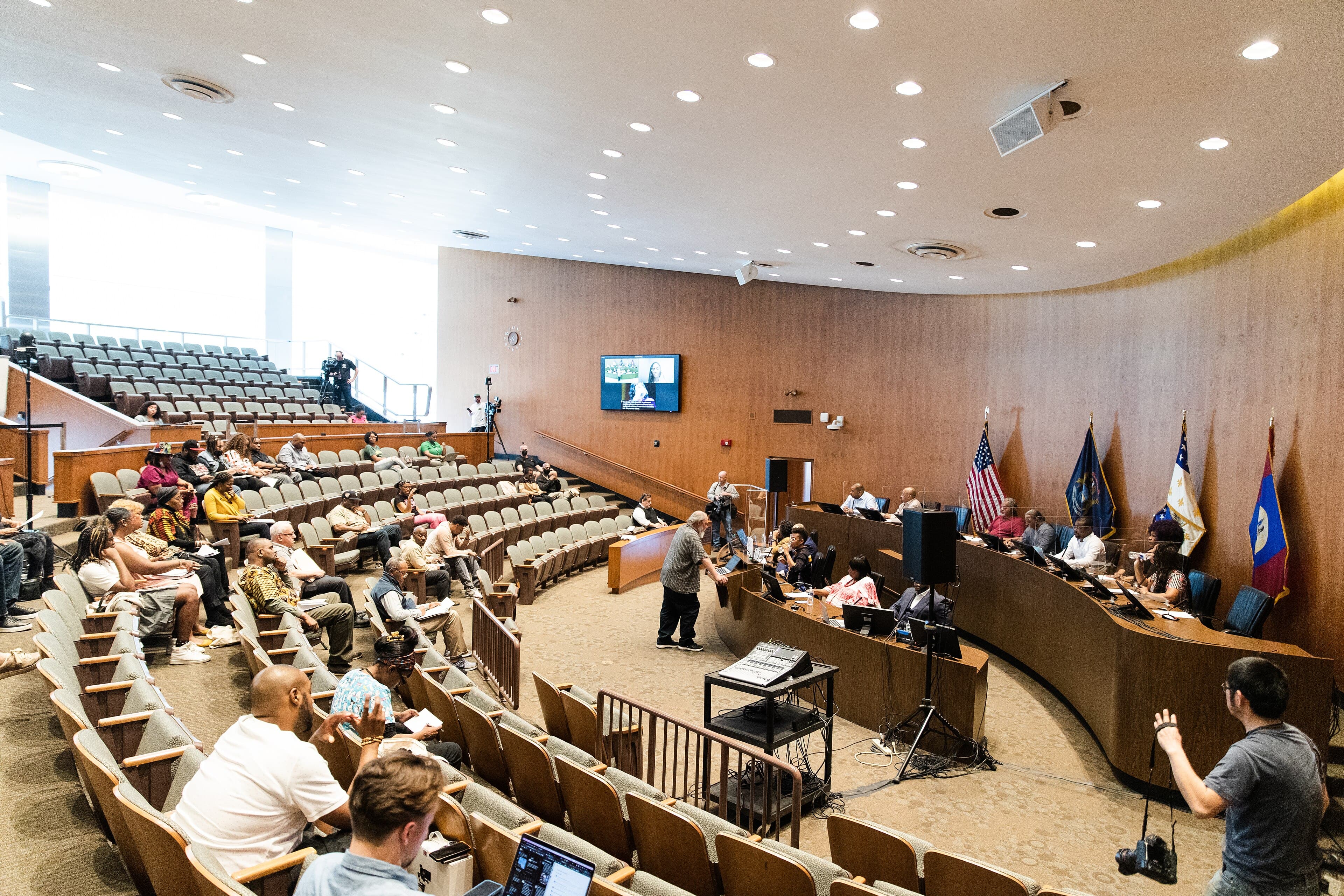
Start with the vote. On June 30, 2026, City Council extended Detroit's ShotSpotter contract roughly $2 million through March 2027, 5–4, over a committee recommendation to reject. The system's own record was on the table: of the first deployment's 5,853 alerts, two produced arrests — 0.03 percent. In the 2024–25 period, alerts led aid to reach a victim in under one percent of activations. The police chief's arrest figures moved between briefings — 256 in one room, 78 in another, weeks apart — and no reconciliation has been published.
This wasn't a one-off. In October 2025, the Michigan Court of Appeals ruled that Detroit had approved earlier ShotSpotter contracts in violation of its own surveillance-transparency ordinance — the law that requires a public review posted 14 days before any vote. The oversight board charged with watching police technology has said, on the record, that it never saw the contract. And nationally, the market is voting the other way: Chicago decommissioned the system after its Inspector General found 88.7 percent of alerts turned up no gun crime; New York's comptroller declined to register the NYPD's renewal; the vendor posted a $9.4 million loss and disclosed a material weakness in its own financial controls.
Every one of those facts was public before the vote. Council approved the spending anyway. Reasonable people can disagree about a technology's promise — but a promise is exactly what this purchase was, because the evidence wasn't there.
Every one of those facts was public before the vote.
What the yes votes said — and the numbers that moved under them
Two of the five yes votes left a clear public reason. Council member Scott Benson: “This is not just about law enforcement, this is about human lives.” Council member Renata Miller: “We need a deterrent, and we do not accept that gunshots is a normalcy in Detroit, especially on the east side of Detroit.” Both are values-based arguments, not data arguments — and neither engaged the 0.03 percent figure on the table that day.
The other three yes votes are harder to trace. Council member Angela Whitfield-Calloway voted no on ShotSpotter's 2022 expansion — “I cannot support spending $8 million on in my opinion, failed technology” — and yes in 2026, with no public explanation of the change found in available reporting. Council President Pro Tem Coleman Young II and Council member Latisha Johnson voted yes without a specific justification traceable in local coverage reviewed for this story (Johnson had pressed Chief Bettison on how DPD measures effectiveness at a March budget briefing, weeks before voting yes). To be precise about what that gap means: some coverage — including the Detroit News — sits behind a paywall this project can't access, so “no explanation found” is not the same claim as “no explanation given.”
The no votes, by contrast, engaged the data directly. Council member Denzel McCampbell, voting no: “arrests only follow two to 3% of the alerts, that aid is rendered to victims that are less than 1% of the calls or cases.” Council member Mary Waters, voting no: “They have not been able to demonstrate the data or otherwise that ShotSpotter actually works and that it actually saves lives.”
Meanwhile the arrest count itself kept moving. A slide deck Chief Bettison presented to the Board of Police Commissioners on March 6, 2025 put “arrests connected to ShotSpotter alerts” at 401 for 2023 and 373 for 2024. At a March 23, 2026 budget briefing, he cited 256. At the May 18, 2026 Council meeting, weeks before the vote, he cited 78. Four numbers, four different rooms, no published reconciliation between any of them — and a different metric and time window than the 0.03 percent figure from the underlying performance data. That's not evidence of dishonesty; the honest reading is that “arrests,” “arrests connected to alerts,” and “alerts resulting in an arrest” aren't the same measurement. But if the numbers can't be reconciled, they can't be the basis for a vote either.
The city's own next step is a DPD–University of Michigan “academic review” of ShotSpotter, which Deputy Chief Mark Bliss told a Council committee on June 22, 2026 was underway. Its funder, scope, and reporting date are still undisclosed. That review — done independently and published before the March 2027 deadline — is the plainest test of whether the next vote gets a real number or a fifth one.
Four numbers, four different rooms, no published reconciliation between any of them.
The pattern is bigger than one contract
Project Green Light is nine years old, 850-plus locations deep, and rated “ineffective” at reducing violent crime by the Department of Justice's own research arm. It has never received the independent audit that rating begs for. The city's freeway license-plate readers run roughly $6.25 million through June 2029 while 30-plus localities nationwide have canceled the same vendor's systems. Police drones are, in the chief's words, “on the road map” — studied against other cities, pitched in part for drag-racing enforcement — before any cost, scope, or rules have been published.
Add it up and Detroit has spent more than $34 million on surveillance technology in a decade. Across that same decade, the purchases have followed a consistent sequence: the technology arrives, the evidence question comes later, and the public review — where it happens at all — happens after the practical decision has been made. A court has already found the review step was skipped once. The sequence is the story.
Meanwhile, the thing that works is measurable
Here is the uncomfortable comparison. Detroit's homicides fell to 165 in 2025 — the fewest since 1965 — and the interventions with the strongest evidence behind that kind of drop are not sensors. A randomized trial across 541 Philadelphia lots found cleaning and greening vacant land cut gun assaults 29 percent in poorer neighborhoods. Community violence intervention and summer youth employment carry real, published effect sizes. Detroit's own ShotStoppers CVI program reports large reductions in its zones — though the city grades its own homework there, and independent evaluation is overdue.
The point isn't that surveillance can never work. The point is that one column of the budget carries randomized trials and sixty-year lows, and the other carries a court ruling, an “ineffective” rating, and 0.03 percent — and the second column is the one that keeps getting funded without conditions.
One column carries randomized trials. The other carries 0.03 percent.
The advocacy the public heard — and what it wasn't told
When the renewal came up, the loudest community testimony in favor came from Live In Peace, a violence-intervention group whose pastor-director spoke passionately for keeping the technology. What was never stated at the podium: Live In Peace has been a ShotStoppers grantee since June 2025 — eligible for up to $1.4 million a year through the very program created as the alternative to surveillance spending.
The facts here deserve precision, because they cut in more than one direction. The grants are not conditioned on supporting any technology. Most ShotStoppers grantees took no position on ShotSpotter at all. There is no evidence of a quid pro quo, and we do not allege one. But disclosure is not optional in public comment for a reason: Council members weighing “community support” deserve to know when the community speaking is also a city vendor — and so does everyone watching from the gallery. The tie was real, it was material, and it went unsaid. That is a process failure the city can fix with one rule: paid partners disclose the relationship when they testify.
What an evidence standard would look like
None of this requires believing anyone acted in bad faith. It requires noticing that Detroit has no working evidence gate between a vendor's pitch and a Council vote. Other cities have built one: an independent performance audit before any renewal; published effectiveness data in the 14-day CIOGS review; a sunset default so contracts expire unless the data justifies them; and a disclosure rule for paid city partners testifying in public comment.
Detroit already owns the legal machinery — the surveillance ordinance exists, the court has enforced it once, and a new administration has every incentive to be the one that made the money follow the math. The question for Council President and the members who voted yes is simple, respectful, and overdue: what evidence standard will the next surveillance dollar have to meet?
Voices
“We can't provide oversight about something if we don't know what it is.”
Linda Bernard
Detroit Police Commissioner
BOPC public session
“This is not just about law enforcement, this is about human lives.”
Scott Benson
Detroit City Council, District 3
Michigan Advance, Jun 30 2026 ↗“We need a deterrent, and we do not accept that gunshots is a normalcy in Detroit, especially on the east side of Detroit.”
Renata Miller
Detroit City Council, District 5
ClickOnDetroit, Jun 30 2026 ↗“Arrests only follow two to 3% of the alerts, that aid is rendered to victims that are less than 1% of the calls or cases.”
Denzel McCampbell
Detroit City Council, District 5 at-large
ClickOnDetroit, Jun 30 2026 ↗“They have not been able to demonstrate the data or otherwise that ShotSpotter actually works and that it actually saves lives.”
Mary Waters
Detroit City Council, District 5 at-large
Fox 2 Detroit, Jun 30 2026 ↗Questions worth asking
Good questions for a good decision
- 01
What independent evaluation, if any, reviewed ShotSpotter's Detroit performance data before the June 30 vote?
- 02
Will the city publish a single reconciliation of the four arrest figures cited since 2025 — 401, 373, 256, and 78?
- 03
What changed Council member Whitfield-Calloway's position between her 2022 no vote and her 2026 yes vote?
- 04
Will paid city partners be required to disclose that relationship when testifying in public comment?
- 05
What is the funder, scope, and reporting date of the DPD–University of Michigan academic review announced June 22, 2026?
- 06
What evidence threshold will the drone first-responder program have to meet before purchase — and will it be published in the 14-day review?
What a strong, open process looks like
Shared ground most people can agree on
An independent performance audit before any surveillance renewal or expansion.
Effectiveness data published inside every 14-day CIOGS review window.
Sunset defaults: surveillance contracts expire unless the data justifies renewal.
A disclosure rule for paid city partners speaking in public comment.
Dates & decision points to watch
Sep 2022
Whitfield-Calloway votes no on ShotSpotter's expansion, calling it “failed technology”; she would vote yes on the 2026 renewal.
Oct 2025
Michigan Court of Appeals rules Detroit approved ShotSpotter contracts in violation of its surveillance ordinance.
Mar 6, 2025
Chief Bettison presents the Board of Police Commissioners a slide citing 401 (2023) and 373 (2024) arrests “connected to” alerts.
Mar 23, 2026
Bettison cites 256 arrests at a Council budget briefing.
May 18, 2026
Bettison cites 78 arrests at a Council meeting — a fourth, unreconciled figure, weeks before the vote.
Jun 22, 2026
Deputy Chief Mark Bliss tells a Council committee DPD is partnering with the University of Michigan on an independent “academic review” of ShotSpotter in Detroit.
Jun 30, 2026
Council extends ShotSpotter ~$2M through March 2027, 5–4, over a committee rejection recommendation.
2026–27
Police drone program “on the road map”; expanded purchase expected to reach Council. The 14-day window is the public's opening.
Primary sources
- Detroit City Clerk — Council agendas & session records
- Michigan Court of Appeals — CIOGS ruling coverage (BridgeDetroit)
- DOJ / NIJ CrimeSolutions — Project Green Light rating
- Chicago OIG — ShotSpotter alert outcomes
- Branas et al. — randomized greening trial (PNAS)
- Michigan Advance — ShotSpotter cost-benefit questions
- City of Detroit — Bettison's Mar 6, 2025 BOPC slide deck (PDF, 401/373 arrest figures)
- BridgeDetroit — DPD chief defends ShotSpotter, cites 256 arrests (Mar 2026)
- BridgeDetroit — the 78-vs-256 gap and the DPD–UM academic review (Jun 2026)
- ClickOnDetroit — Miller and McCampbell floor statements (Jun 30, 2026)
- Fox 2 Detroit — Mary Waters floor statement (Jun 30, 2026)
- Fox 2 Detroit — Whitfield-Calloway's 2022 no vote
Every claim on this page links to its source. Some figures come from reporting that should be re-confirmed against primary records before a public hearing — we'd rather you verify than trust us. If you find an error, tell us and we'll fix it.
Show up when it counts
Decisions get made in rooms.
We'll tell you which room, and when.
The most powerful thing a resident can do is be present before the vote. Subscribe and we'll email you ahead of every City Council session, Police Commissioners meeting, and public hearing that shapes our city.